Vector Spaces
6.1#
Suppose that
is the set of quadratic functions which have graphs opening upwards.
Define addition of functions by the usual rule, so that for example
and define scalar multiplication also by the usual rule, so that for example
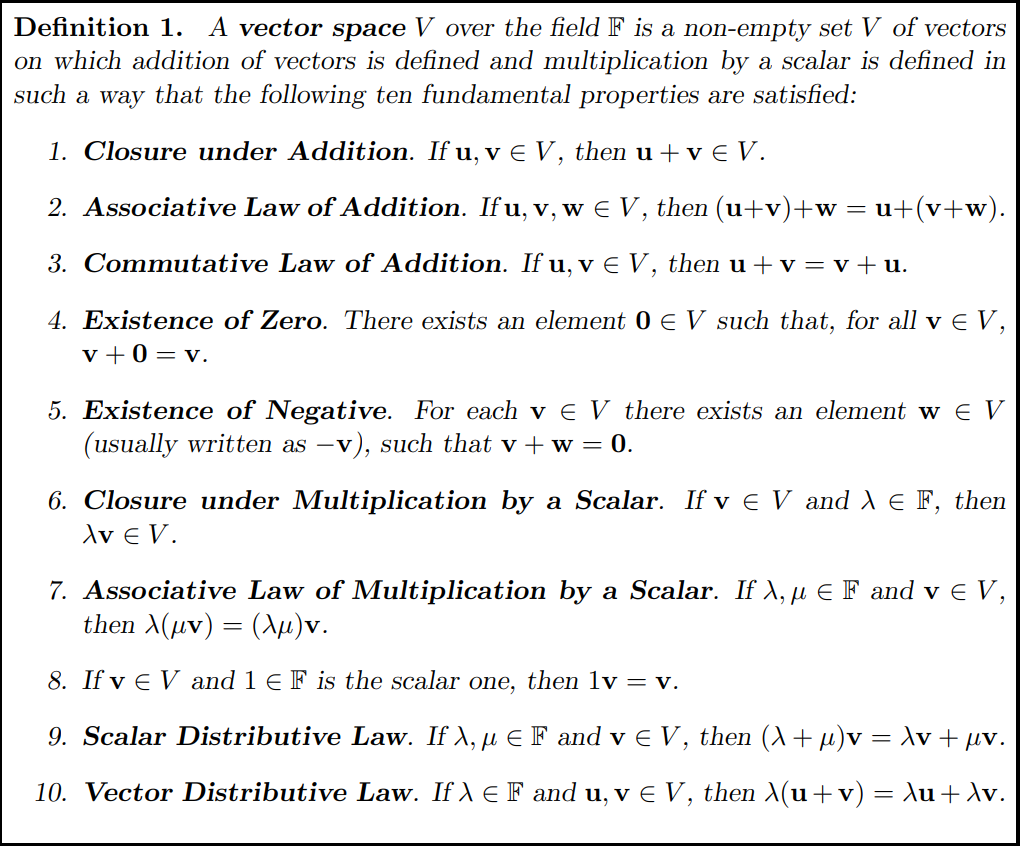
Which of the following 10 properties of a vector space are satisfied?
- Since , any , do not matter hence this is satisfied.
- Self-explanatory, satisfied
- Self-explanatory, satisfied
- Since , there can not be a vector, not satisfied
- Since , there cannot be a negative vector, not satisfied
- Suppose , , , meaning it is no longer in , not satisfied
- Self-explanatory, satisfied
- Self-explanatory, satisfied
- Self-explanatory, satisfied
- Self-explanatory, satisfied
The 13th century Italian mathematician Leonardo of Pisa was also known as Fibonacci.
Sometimes we like to consider sequences , where , just like vectors. Now consider the set of Fibonacci-type sequences, that is
Define vector/sequence addition and scalar multiplication (over ) of elements of component-wise, so that for example
and
Which of the following 10 properties of a vector space are satisfied?
We only have to check due to the subspace theorem,
- If you have two valid Fibonacci sequences and , and you add them together to make a new sequence , does it still follow the rule? Yes. .
- The 0 vector is valid since .
- If you multiply a Fibonacci sequence by a scalar , every term is multiplied by . Does ? Yes, you can just factor the out of the right side to see it perfectly holds.
- This is just property 6 using the specific scalar . Because scalar multiplication works, multiplying a sequence by gives a valid sequence that perfectly cancels out the original.
6.3#